
- Home
- About
- Support
- Data Access
- Data Analysis
- Data Products
- Publications
-
Links
Databases NED Simbad GCN circulars archive GRB data table Software & Tools Swift Software (HEASoft) Xanadu WebPIMMS Institutional Swift Sites GSFC PSU OAB SSDC MSSL University of Leicester
Swift Observation Types and Target IDs
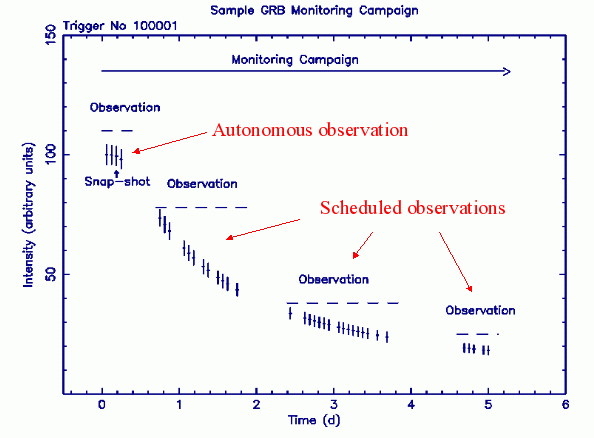
There are three fundamental observation timescales for Swift:
- Snapshot
- This is the time spent observing the same position without a break. Because of observing constraints, this is shorter than a single orbit of the Earth (which lasts ~96 minutes). The configuration of the instruments (e.g. mode and/or filter) can change during a snapshot.
- Observation or Observation Segment
- An observation is a cluster of snapshots of the same target. The length of an observation will vary, depending on the planning of the science timeline.
- Monitoring Campaign
- Some targets will be observed several times, depending on the evolution of the flux, the sensitivity of the instruments and the science aims. The different observations of a single target make up a monitoring campaign. There is no maximum time set for the number of observations of a target, or the duration of the monitoring campaign, but it expected that GRB targets will generally be monitored for about a month.
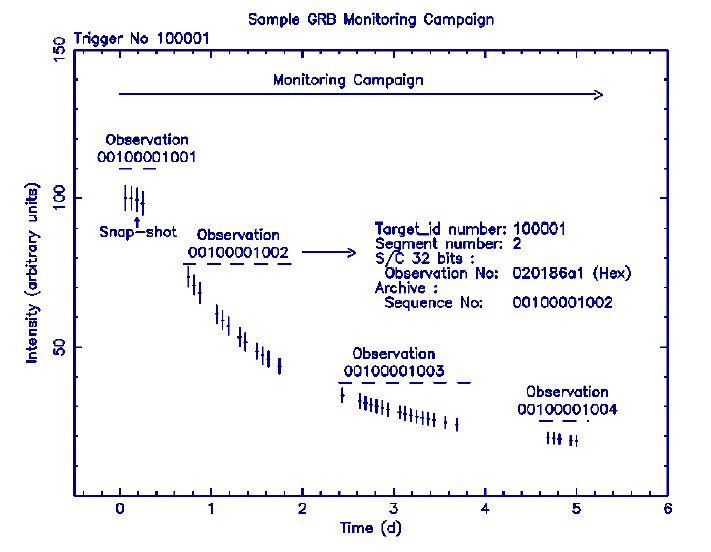
Objects will be assigned both a (unique) 24-bit Target ID number and an 8-bit number for the Observation Segment. The allocation of Target IDs and Observation Segments is summarised in the table below (though users should be aware that the convention is subject to change).
| 0 | Reserved for spacecraft: safehold or spacecraft fails to assign a number. |
| 1-6 | Used for safe pointings. |
| 7-999 | Reserved for spacecraft; currently not planned to be used. |
| 1 000-9 999 | Unassigned. |
| 10 000-19 999 | Non-GRB ToOs. Previously assigned to BAT catalogue (known sources) |
| 20 000-29 999 | GRBs from other missions, or discovered from ground analysis of BAT data. |
| 30 000-39 999 | Non-GRB ToOs or fill-in targets. |
| 40 000-49 999 | This range is used for fill-in targets and reassigned Target IDs for safe pointings. The reassignment occurs on the ground to remove the degeneracy of the several sky positions used for safe pointing for which only 6 Target IDs are available and assigned onboard. |
| 50 000-59 999 | Calibration observations performed during the mission. |
| 60 000-69 999 | Non-science observation. |
| 70 000-79 999 | Non-science observations. |
| 80 000-81 999 | Assigned for simultaneous observations with NuSTAR. |
| 82 000-87 999 | Non-science observations . |
| 88 000-89 999 | Assigned for simultaneous observations with NuSTAR. |
| 90 000-99 999 | Guest Investigator observations. |
| 100 000-2 999 999 | BAT triggers. Target IDs are assigned to all triggers, even if they are judged onboard not to be good GRBs. |
| 3 000 000-3 999 999 | Range of categories |
| 7 000 000-16 777 214 | Tiling observations for follow-up of gravitational wave triggers. |
| 16 777 215 (=$FFFFFF) | Reserved to indicate that the reporting subsystem does not know the correct Target ID. |
Every observation is tagged with an Observation Number, which is the 32-bit concatenation of the Target ID and Observation Segment discussed above. There is also the Sequence Number, which is the decimal representation of the 32-bit Observation Number, in the form of an 11 digit value; the first 8 digits are for the Target ID and the remaining 3 for the Observation Segment. It is these 11 digits, the Observation ID, which are used for the naming of the data directories, possibly with a processing version appended: i.e. sw[obsid].[ver] (from the US site; or [obsid] from the UK site). Using the example in the diagram below, the Target ID is 100001 and the observation segment is 2, since it is the second observation of the target in question. Thus, the 11 digit sequence number is 00100001002.
UK Swift Science Data Centre
Last updated 2011 December 05
Web page maintained by Kim Page
E-mail: swift help
Please read our privacy notice.